








Index Sync and the new IRS notice: Where we think the line belongs

Srikanth Narayan
Founder and CEO
Before I started Cache, about 90% of my net worth was in a single stock. Having so much of my financial future tied to one company was nerve-wracking. I was looking for a way out, and that's when a wealth manager introduced me to exchange funds. They were exactly what I needed: a way to diversify tax-efficiently.
Though these funds had been available for decades, no one around me seemed to know anything about them. It wasn’t surprising: high minimums, high fees, private wealth clients only, and a clunky experience stuck in a commission-based sales era. I immediately knew there was an opportunity to build a much better product for a problem that was becoming all too common: concentrated wealth.
So we built a new exchange fund platform from the ground up. A clean sheet of paper meant that we could rethink how things are built. But working in a regulated industry means doing things extremely carefully. We wanted to make exchange funds accessible, not to change the rules underneath them. We studied the structures that came before us, and the legal underpinnings of their features.
One feature of existing exchange funds stood out. Established managers pooled their funds' diversified holdings into a larger fund, giving investors far broader diversification than a single exchange fund could reach on its own. We wanted that benefit for our investors too.
So we introduced Index Sync to our portfolio management toolkit: our funds contribute a portion of their holdings to newly launched ETFs to diversify more broadly and track their benchmarks more closely.
On September 28, Treasury and the IRS issued Notice 2026-62, along with a revenue ruling. We read both closely. The ruling goes after a real problem, and we think it's right to. The notice asks for comments and mentions exchange funds, so here's what it says and where we stand.
What the ruling goes after
Two tax rules sit at the center of this. Section 351 lets investors contribute stock to a new ETF and receive its shares in return without triggering taxes, and it’s a common way to launch one. Section 852(b)(6) lets an ETF swap stock through a trading firm (known as an authorized participant), without the ETF paying tax on the gain. ETFs do this regularly (it's integral to how index ETFs rebalance).
The ruling targets one specific way of combining the two, which we'll call the "ETF Swap":
- As part of a plan, an investor puts a diversified portfolio of stock into a brand-new ETF. Some or all of it isn't a fit for what the ETF plans to hold.
- Shortly after launch, under the same plan, the ETF uses a trading firm to swap the investor's stock for the portfolio it actually wants. Section 852(b)(6) enables the ETF to do this tax-free.
- The ETF ends up with a portfolio that fits its strategy and is "materially different" from the one the investor put in.
In the IRS's view, the ETF in this sequence is "merely a conduit," and the investor has really just swapped their stock with a trading firm. So the ruling taxes the investor as if they'd made that trade directly. We think the ruling treats that transaction fairly.
What the notice says about exchange funds
The accompanying notice describes a version involving exchange funds. Investors contribute stock to a partnership that holds at least 20% of its assets in things other than stocks and securities (typically real estate), the partnership ends up with a diversified portfolio, and then, "as part of the same plan," it takes part in the ETF Swap described above. Treasury is considering guidance on that pattern and has asked for public comments by October 28.
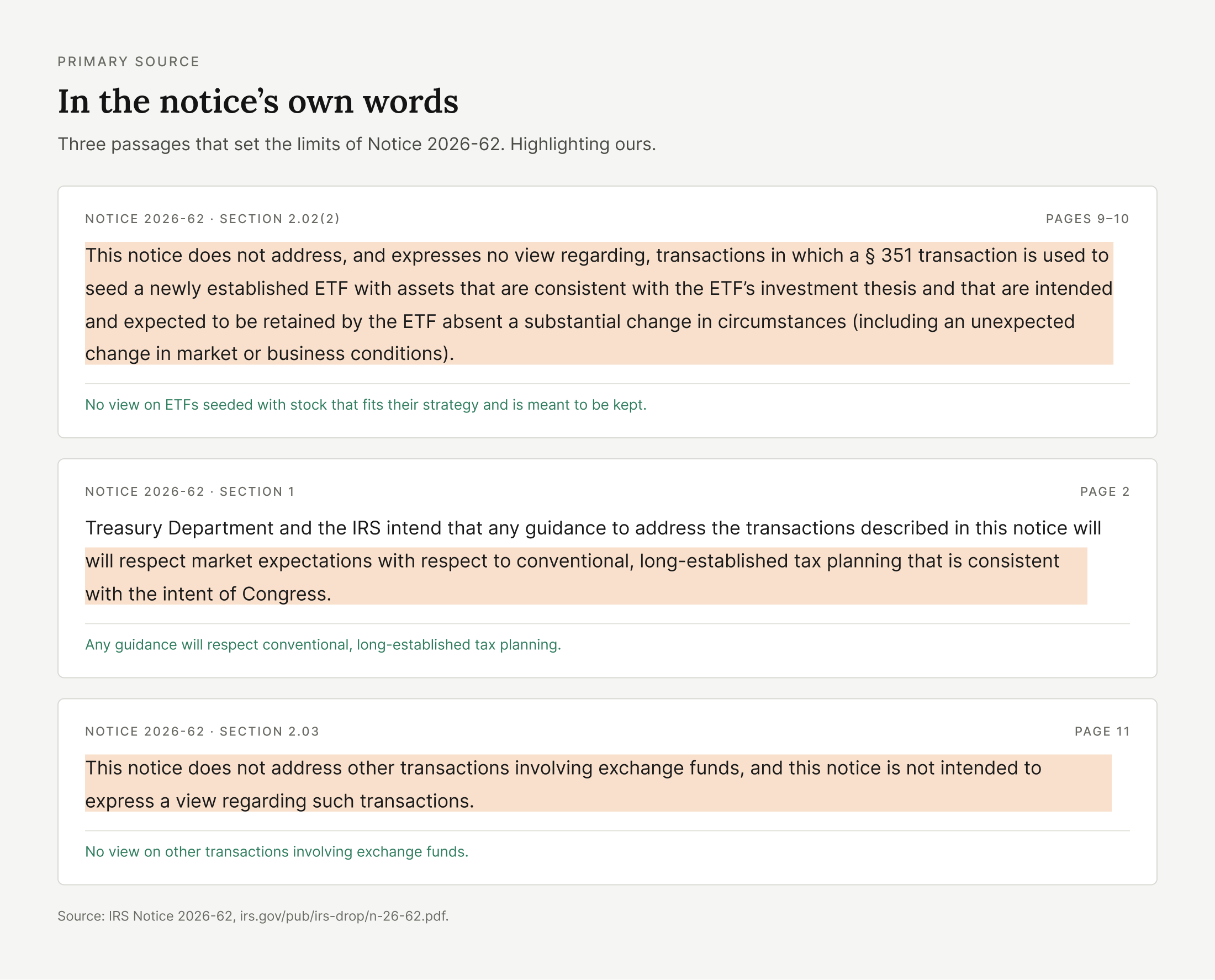
And it sets its own limits. In its words:
- It "does not address, and expresses no view regarding," seeding a new ETF "with assets that are consistent with the ETF's investment thesis."
- It "does not address other transactions involving exchange funds."
- Treasury and the IRS say they intend any guidance to "respect market expectations with respect to conventional, long-established tax planning that is consistent with the intent of Congress."
The rest of this article lays out why the exchange fund steps are long-established practice across the industry.
How exchange funds work
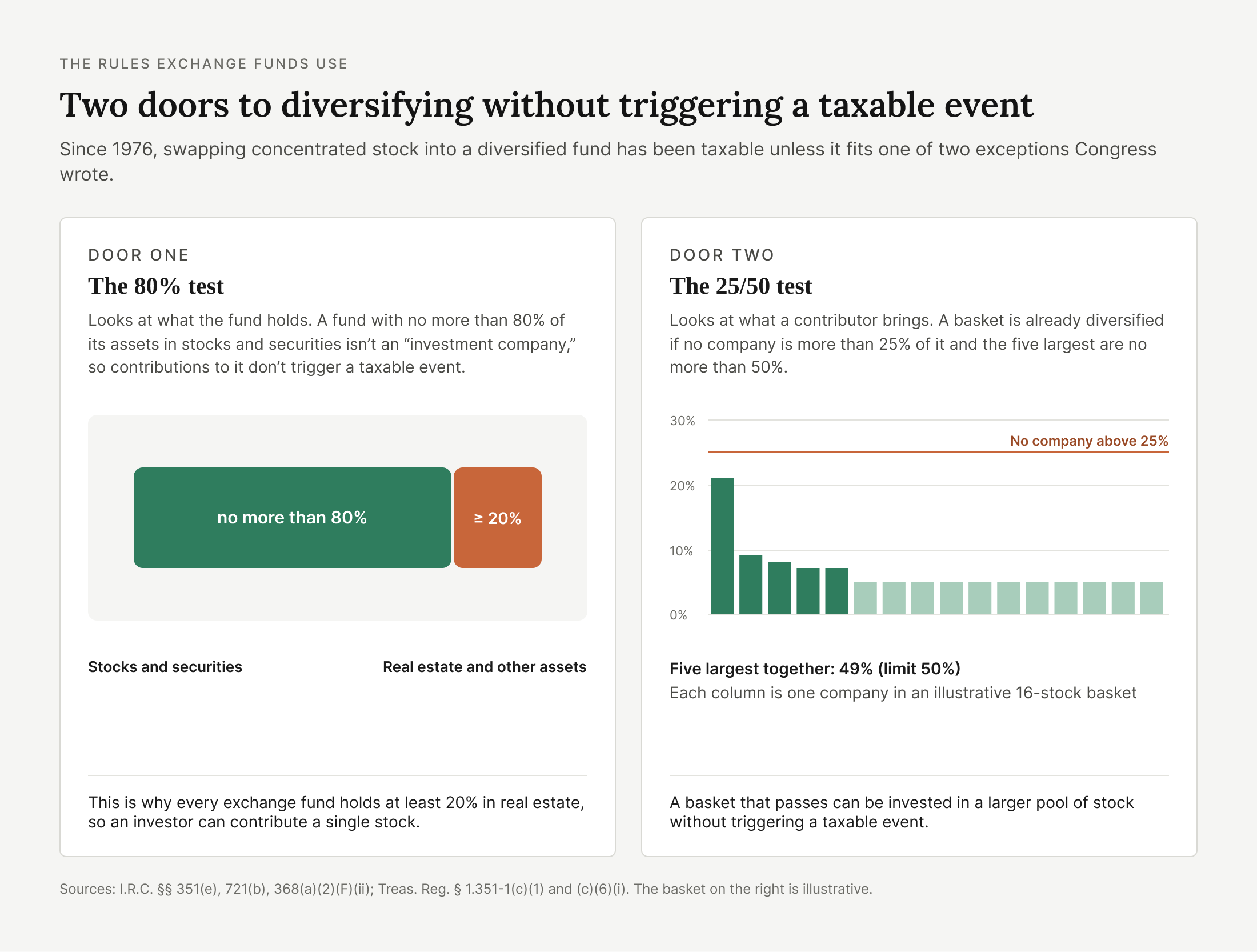
An exchange fund lets you diversify a concentrated stock position without selling it, and the tax on your gain is deferred instead of triggered. Two long-standing rules make that possible. Think of them as two doors.
- Door one: the 80% test. Contributing a single stock to a partnership doesn't trigger tax when no more than 80% of the partnership's assets are stocks and securities. That's why exchange funds hold at least 20% in other assets, typically private real estate.
- Door two: the 25/50 test. A basket of stocks counts as already diversified when no single company is more than 25% of it and the five largest are no more than 50%. When everyone brings an already-diversified basket, pooling them into a larger fund, whether a partnership or an ETF, isn't treated as diversifying anyone, so it doesn't trigger tax under these rules. Treasury proposed this rule in 1995 to make clear that "combinations of already diversified portfolios are not inconsistent with the purposes of section 351(e)," and adopted it in 1996. Congress left it in place when it revised these rules in 1997.
Exchange funds defer tax; they don't eliminate it. Your gain stays attached to your contribution, and a seven-year rule keeps the fund from passing your stock to someone else, or handing you different assets, without triggering that gain. Tax generally comes due when you sell what you receive after you leave. What you get is diversification now, and more control over when you realize your gains.
Exchange funds have worked this way for decades
The precedent we studied is a series of exchange funds sponsored by a leading provider, one of the largest in the country. Its funds filed reports with the SEC, so every step can be read in public documents. Let's call it the "Traditional" series. We use it as an illustration of what long-established practice looks like.
Investors contributed concentrated stock to an exchange fund in the series that was onboarding new investors. Each of these funds was designed to keep at least 20% of its assets in real estate (door one). At each closing, the exchange fund contributed 100% of the stock it had received to an intermediate fund, the "Master Fund," which immediately contributed it to a larger registered mutual fund run by the same provider, the "Registered Fund." That's door two, twice. From 1996 through 2023, the Registered Fund at the bottom took in more than $34 billion of in-kind contributions, by our tally of its SEC reports.
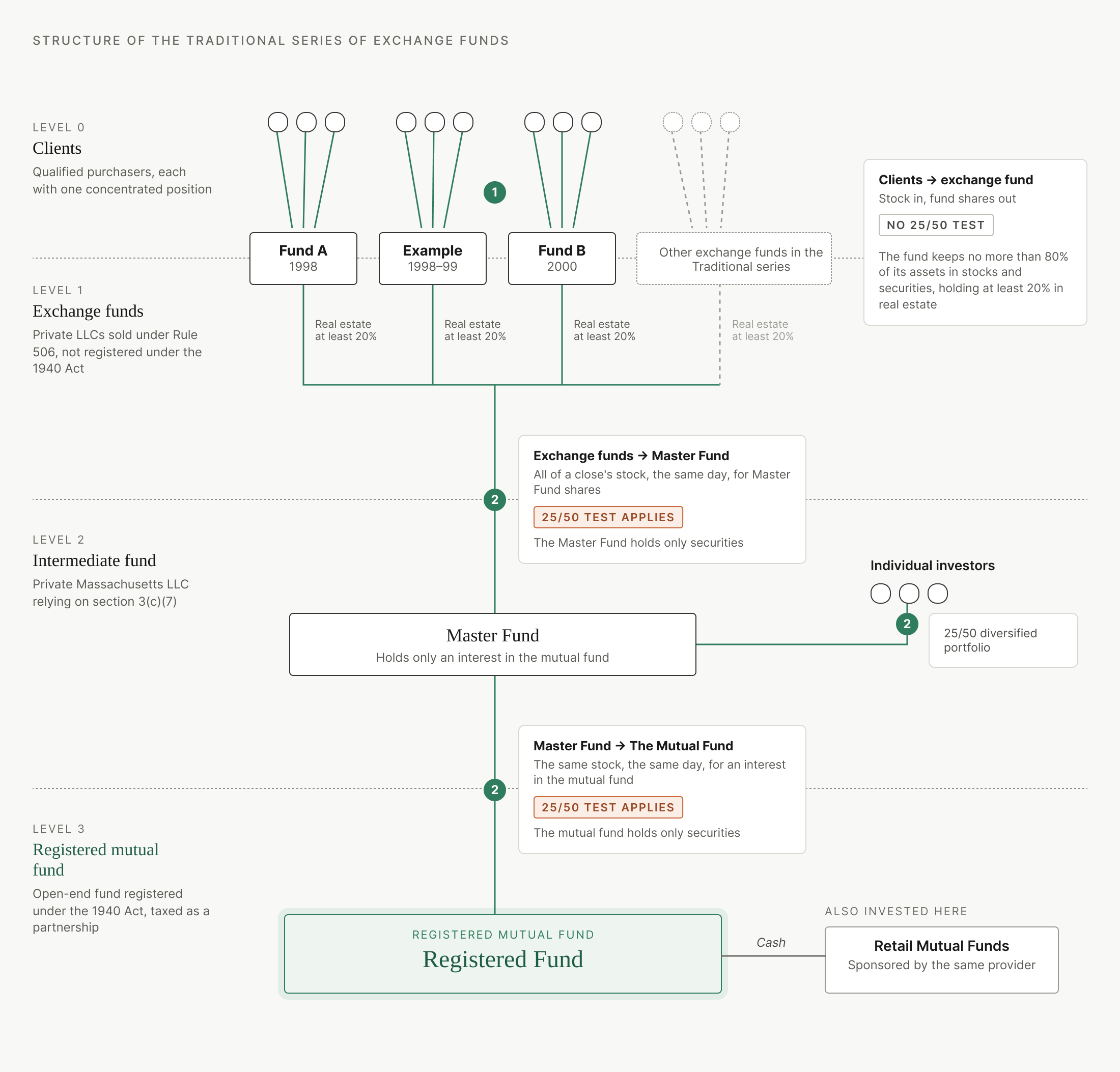
What that meant for investors. Someone who contributed a single stock into any exchange fund gained a stake in a far broader portfolio accumulated over decades in the Registered Fund. In the second half of 2016, for example, the Registered Fund took in about $736 million of contributed stock. The three biggest additions, Qualcomm, Marriott and EOG Resources, came to roughly 30% of that amount. Inside the Registered Fund, which held more than 450 companies, each of those three ended the year at 1.5% or less. Its largest holding, Alphabet, was 3.7%. And each contributor's built-in gain stayed allocated to them.
What this precedent shows is that the steps our funds follow—pooling concentrated stock and contributing diversified baskets to a larger, more diversified fund—are conventional, long-established, and publicly disclosed. They are in line with what Congress intended, and with what the Treasury adopted.
How our funds use ETFs
Index Sync is our version of door two. Here's why we need it.
An exchange fund builds toward its benchmark by pooling contributions of appreciated stocks from many investors. Selling contributed stock defeats the purpose, because it realizes the gains investors came to defer. So building a diversified fund is a game of Tetris. Some pieces come in constantly, and others come in less predictably. We need a balanced mix to clear the board and onboard investors into the fund. When the right piece doesn't come, the board can stack up unevenly, and the fund drifts from its benchmark. That drift, called tracking error, is a real risk that the portfolio managers have to keep in check.
Index Sync fills the gaps. Beginning in July 2025, our Flagship funds contributed a portion of their holdings, as diversified baskets, to newly launched broad-market U.S. equity ETFs run by Alpha Architect. At each launch, our funds were minority contributors. In all, they contributed alongside hundreds of unrelated investors, each bringing a diversified basket.
In return, the exchange funds received ETF shares. On each ETF's first day, those shares gave our funds exposure to roughly 415 to 570 stocks, providing broader diversification and reducing tracking error. Our funds obtained that broader exposure when their baskets joined the other contributors' portfolios. They would obtain substantially the same diversification even if section 852(b)(6), the rule that makes the ETF's redemptions tax-free, did not apply.
Only a portion of an exchange fund goes in. Every fund keeps holding individual stocks, keeps accepting new investors, and keeps declining stock that doesn't fit its benchmark. In contrast, the “Traditional” structure discussed above moved 100% of the securities from each closing into the Registered Fund.
Three facts matter most here:
- Every basket must fit the ETF. According to Alpha Architect, it accepts only diversified baskets that are consistent with the ETF's prospectus, and before each launch it models the combined portfolio of all proposed contributions to confirm they meet the ETF's investment objective.
- No plan for an ETF Swap. We have no plan or agreement, formal or informal, with the ETF, its manager or any trading firm for the stock we contributed to be swapped out using 852(b)(6). Cache has no role in managing the ETFs, by design.
- Your deferred gain stays with you. Under the existing rules, your built-in gain stays tracked to you through the ETF shares, just as it was through the stock. The seven-year holding period still applies.
We built Index Sync after 18 months of research. K&L Gates gave us written tax and regulatory opinions on Index Sync before our first contribution, and has now written to Treasury on our behalf.
Where we think the line belongs
We believe the rules should distinguish a contribution made for bona fide investment-management purposes, supported by the regulations that Treasury adopted, from a planned transaction that carries out an ETF Swap. Here’s how the two compare:
Combining diversified baskets is what exchange funds have long done, and what the rules have allowed since 1996. The problem is the ETF Swap: an ETF launch set up from the start to take stock in and hand it right back out, tax-free under section 852(b)(6). That's where we think the line belongs.
Long-established providers, like the one behind the Traditional series, pooled investors' baskets inside their own fund families, built over decades. Index Sync gives our funds the same kind of pooling by contributing alongside other unrelated investors to newly launched ETFs from an unaffiliated ETF sponsor. The 25/50 rule applies the same way to both. Guidance that allowed pooling within an established firm’s own fund family but restricted comparable pooling through an unaffiliated fund would favor the largest providers over independent managers pursuing the same investment purpose.
Tax rules work best when they're clear and well targeted. We believe the ruling is aimed at the ETF Swap, and we support it. We've asked Treasury and the IRS to keep any new rules just as focused: apply them to an exchange fund only when it takes part in an ETF Swap, and not when there is no planned misuse of section 852(b)(6).
What we're doing
On October 19, we filed comments with Treasury and the IRS, alongside a letter from our counsel at K&L Gates.
You can read the letters here: Cache Comment Letter and our counsel's K&L Gates Comment Letter.
We have paused Index Sync while we wait for guidance. In the meantime, we're filling the gaps in our funds through targeted marketing programs and growing the funds in a balanced way.
Comments are open until October 28 and are posted on the public docket (comments appear once approved). If you or your tax advisor has a view on where the line belongs, you can add yours there. Leave out personal account details, since comments are made public.
I'm an investor in the Cache Exchange Fund alongside you, and alongside thousands of others who have trusted Cache with over $2.5B in assets. We don’t take that lightly. We build carefully and responsibly. We'll keep standing up for clear, well-targeted rules that investors can rely on, and we'll keep you posted as this develops. If you have questions, reach out; we're always happy to talk.
This article is for informational purposes only and is not tax, legal, or investment advice. The historical example describes funds sponsored by a provider that is not affiliated with Cache. Alpha Architect is not affiliated with Cache. Companies named are for illustration only and are not recommendations. Exchange funds defer taxes; they do not eliminate them. Diversification does not guarantee a profit or protect against loss. All investments carry risk, including loss of principal. Please consult your tax advisor about your situation.
The Cache Exchange Fund can help.


Make better decisions for managing your large stock positions.
Sign up to receive all our insights and data.


