





Exchange Fund vs. ETF: Different Ways to Diversify

Srikanth Narayan
Founder and CEO
Exchange funds and exchange-traded funds (ETFs) can be easy to mix up. They share two words in their names, and both are pooled investments that are typically intended to give you diversified exposure to a broader market or index (while some can be more narrow). But they differ in how they're used and how they're taxed when you diversify, so it's worth knowing which one is more likely to fit the goal you have in mind.
This article walks through how exchange funds and ETFs differ, where they overlap, and the nuances to keep in mind as you weigh them.
TL;DR: Exchange funds and ETFs can both help you diversify, but they work differently and the tax impact is a key distinction.
- Selling a large stock position to buy ETFs (or other taxable security for that matter) triggers capital gains taxes. Contributing that position to an exchange fund doesn't trigger a taxable event.
- ETFs cover a wide range of benchmarks, industries, and geographies. Exchange funds usually track the largest indexes, like the S&P 500.
- Exchange funds are limited to accredited investors and qualified purchasers, carry a seven-year holding period, and typically require contributing stock rather than cash. ETFs are open to nearly anyone and trade freely.
What is an exchange fund?
The "exchange" in "exchange fund" refers to the act of exchanging a concentrated stock position for a stake in a diversified basket of investments.
That basket comes together when many investors, each holding a different concentrated stock, contribute their positions into the fund, a partnership formed among those investors. In return, each investor holds a stake in the fund proportional to what they put in.
This lets people with concentrated positions diversify without triggering taxes. They aren't selling their stock, they're contributing it, so there's no taxable event.
To learn more, read our in-depth guide: What is an exchange fund?
{{black-diversify}}
What is an exchange-traded fund (ETF)?
"Exchange" is used in the term "exchange-traded fund" because ETFs trade on public stock exchanges, just like a stock.
Most ETFs track an underlying index. You’ve probably heard them referred to as index funds, and they benchmark their holdings and performance against that index.
Other ETFs track a sector or a theme rather than an index. With no index to follow, a portfolio manager actively selects the holdings to fit the fund's theme, and that active management usually means higher fees (more on fees below). For example, international ETFs offer exposure to non-US companies, with some even specifically focused on smaller, lower-relative-price, and higher-profitability companies as opposed to an index’s constituents.
Beyond stocks, ETFs can hold bonds, commodities like gold, or other assets, though many view equity ETFs as a relevant comparison when you're diversifying a concentrated stock position.

Time out
Did you know?
If you want broad-market ETF exposure but don't want the tax bill that comes from selling, Cache's Flagship Exchange Fund offers a path. At the end of the holding period, qualified purchasers can indicate their preference to receive a diversified basket of individual stocks, or a mix of both stocks and ETFs.*
*Exchange Funds are intended for long-term investors and typically have higher expenses than ETFs but offer tax deferral versus paying taxes and selling, while Cache will attempt to honor investor preferences. Ultimate redemption decisions are at the discretion of Cache and subject to availability.
Exchange funds vs. ETFs: what's the difference?
The core distinction is that, in most situations, you buy an ETF with cash and you join an exchange fund by contributing stock. That difference drives how each one is taxed, who can use it, and how quickly you can get your money out.
The table below lays out where the two overlap and where they part ways:
What are the fees for an exchange fund vs. an ETF?
Exchange fund fees: the management fee
An exchange fund's fee is called a management fee, charged as an annual percentage of the fund's assets. It's deducted automatically, usually monthly, so there's nothing to pay manually. The cost shows up in the value of your holding.
The fee covers the work of keeping the fund's mix of stocks aligned with its benchmark, along with operational and administrative costs like recordkeeping and custody.
Cache Exchange Funds were designed to be more accessible than traditional exchange funds, including on cost. For current fees, see our Help Center for a complete breakdown of all the fees for Cache Exchange Funds. To compare across providers, see our article, List of exchange funds.
ETF fees: the expense ratio
An ETF's fee is called an expense ratio, which is also an annual percentage. It's applied to the fund's net asset value and taken out automatically, so the daily impact is already reflected in the share price. An expense ratio of 0.03% on $100,000 invested works out to about $30 a year.
Index funds usually carry low expense ratios because they passively track an index. Actively managed ETFs run higher, since a manager is selecting holdings and the fund carries more operational and marketing cost. According to Morningstar’s article, Active Versus Passive ETFs, the average expense ratio at the end of 2025 was 0.14% for passively managed equity ETFs and 0.44% for actively managed equity ETFs, with some active funds charging well above 1%.
The expense ratio matters most over long horizons. If you sell a large holding to buy an ETF, you pay a tax bill now and then carry that expense ratio against your returns for as long as you hold, which for a retirement-length position can be decades. In addition to the expense ratios, many ETFs also have underlying fund expenses and carry ongoing trading expenses that will vary by fund.
Why an exchange fund won't always track the index the way an ETF might
It's tempting to think of an exchange fund as an ETF you pay for with stock. While the concept is similar, the underlying structure is more involved than that. An exchange fund aims for index-like exposure over the long term rather than directly tracking an index day to day.
An S&P 500 ETF is engineered to mirror its index closely because the manager can buy and sell freely to stay aligned.
An exchange fund works differently. Its holdings are whatever investors contribute, and selling those positions to fine-tune the portfolio would trigger the tax consequences the structure exists to defer. The fund approximates a benchmark like the Nasdaq-100 or S&P 500, and it will drift from that benchmark in any given month or quarter.
How much “drift” depends on the fund and on market conditions. In some periods the fund runs ahead of the index; in others it lags. The aim is index-like exposure over a long horizon rather than precise tracking on any given day.
The gap also can't simply be hedged away. Many investors in the fund are current employees of the companies whose stock it holds, and they're often prohibited from any strategy involving derivatives. Using options to close the tracking gap would exclude a large share of the people the fund is built to serve.
Exchange funds aren't all built the same here, and the gap can be narrowed. Cache's Flagship funds, available for Qualified Purchasers, use a feature called Index Sync, which rebalances toward the benchmark through an ETF in a tax-efficient way. This is intended to fill sector gaps without selling individual positions and triggering gains. Early results are encouraging: the Nasdaq-100 Flagship fund has tracked its benchmark at roughly 0.99 correlation. You can read how we built Index Sync here.
When are an exchange fund vs. an ETF typically considered?
The exchange fund option becomes relevant when you're holding a large, highly appreciated position in a single stock, where the gain is big enough that selling would hand a meaningful slice to the IRS. You want to diversify, but the obvious path, selling the stock to buy an ETF, comes with a capital gains bill that shrinks what you have left to reinvest.
A simple way to think about it:
- Consider an ETF when you're investing new money (cash), your existing positions don't carry large embedded gains (high cost basis), and you value daily liquidity and a wide choice of indexes, sectors, and themes.
- Consider an exchange fund when you're holding a concentrated, low-basis position you want to diversify out of, you can commit to the seven-year horizon, and you'd rather defer a capital gains bill (north of 20% for high earners, often more with state tax) than pay it now and reinvest what's left. Note: Exchange Funds defer taxes; however, taxes are due when selling.
These two often aren't competitors. An exchange fund can be the tax-efficient route to the ETF exposure an investor wanted in the first place.
Cache's Flagship funds are built so that at the end of the holding period, qualified purchasers can indicate their redemption preference for a diversified basket of individual stocks, or a mix of broad-market ETFs and individual stocks.
Time out
Can you contribute an ETF into an exchange fund instead of an individual stock?
Generally, no. The tax deferral mechanism requires investors to contribute concentrated positions, and the rules require the fund to be built from holdings that aren't already diversified. An ETF is diversified by design, so it doesn't carry the single-stock concentration the structure depends on.
The tax question: why not just sell, then buy an ETF?
It's the obvious objection: if the end goal is diversified market exposure, why not sell the stock, pay the tax, and buy a low-cost ETF? Plenty of people do. An exchange fund can come out ahead because it defers the tax bill, maximizing how much of your money stays invested, which, while no one can predict the future, has the potential to appreciate further over time.
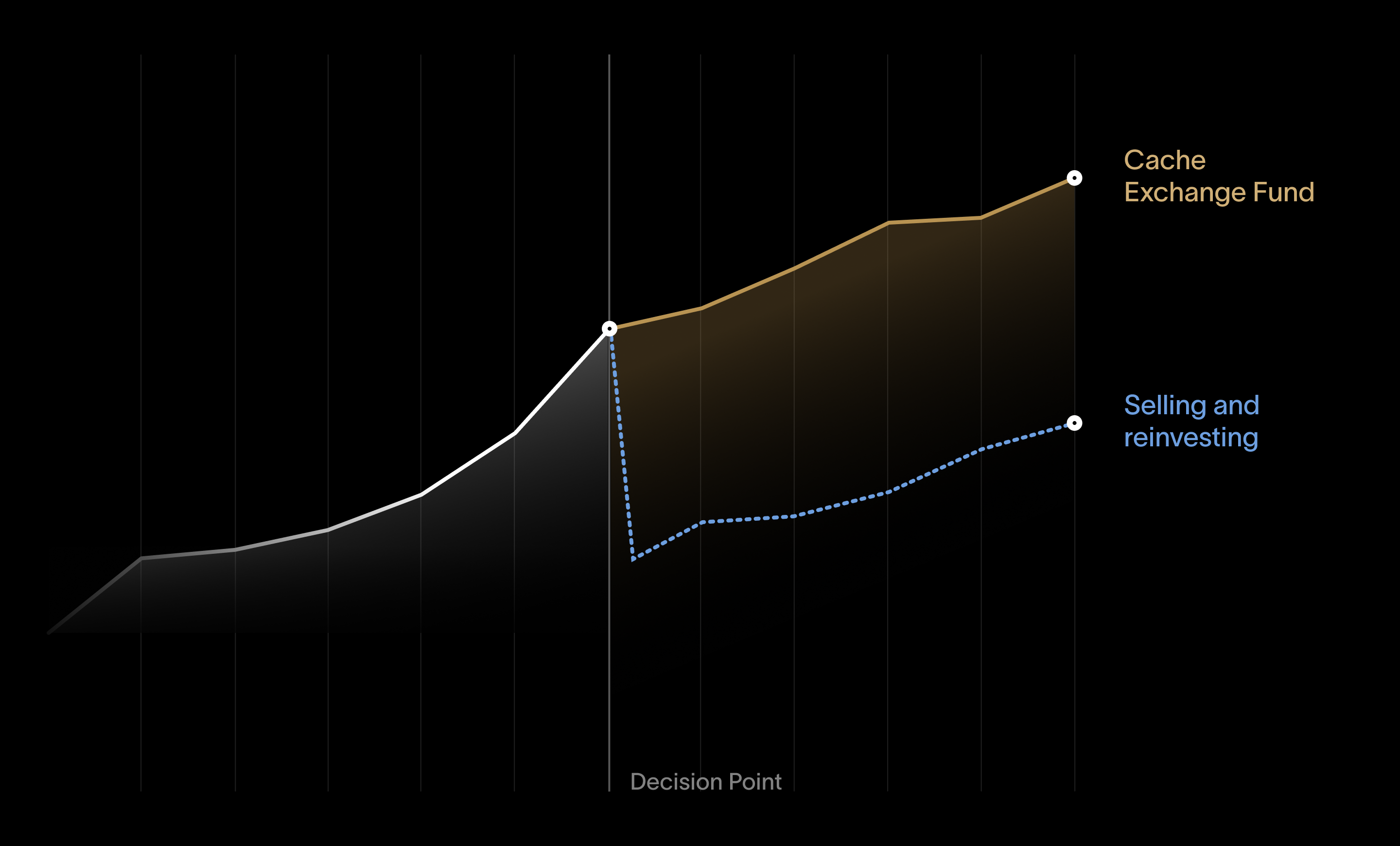
When you sell appreciated stock, the capital gains tax comes out of your capital right away. That's money permanently removed.
An exchange fund defers that tax, so your full position keeps working and no capital gains tax is due. Over a long horizon, compounding on the full amount rather than the after-tax remainder can add up to a significant difference.
Exchange fund investors only pay capital gains taxes when they sell some or all of the diversified basket they eventually redeem. Beyond that, under current IRS rules, heirs may receive the fund units on a stepped-up basis, which could reduce or eliminate the tax liability.
The size of these advantages depends entirely on your own numbers: the size of your gain, your tax rate, your time horizon, and your expected return. Rather than guess, you can model your specific position with our exchange fund calculator.
{{black-diversify}}
Tax laws may change, and this article is educational, not tax advice. Consult your own tax advisor about your situation.
The Cache Exchange Fund can help.

Make better decisions for managing your large stock positions.
Sign up to receive all our insights and data.