

Your net worth rides on one stock
After the IPO, most of your wealth is still tied to SpaceX. One company shouldn't decide your financial future.
For SpaceX employees navigating the windfall, the lockup, and the tax bill.
Cache can help you diversify and defer your taxes.
A tax-deferred approach to your SpaceX proceeds could mean an estimated $600K difference over 10 years.
Used by employeesand investors from




















The core problem
After the IPO, most of your wealth is still tied to SpaceX. One company shouldn't decide your financial future.
Diversifying out of SpaceX triggers capital gains. The more it has appreciated, the more you hand to taxes.
“Diversification is the only free lunch in investing.”
What we offer
Many SpaceX employees will face a combination of taxes, concentration risk, and future liquidity decisions. Cache helps you prepare before those decisions arrive.
Cache Long/Short
Invest cash proceeds from the IPO. A long/short structure is built to harvest tax losses across more market environments, which could help offset future gains.
Typically considered when
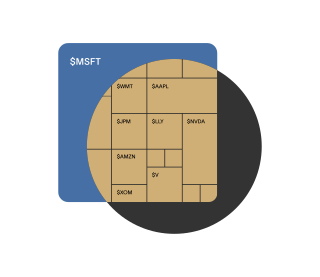
Cache Exchange Fund
Reserve an Exchange Fund path for SpaceX shares today. When eligible, an exchange fund can help you diversify without selling outright.
Typically considered when
Your analysis
Estimate the difference a Long/Short strategy could make. Open the full calculator for detailed assumptions.
Why Cache
We built what we couldn't find.
Est. annual losses harvested
Cache Long/Short
8 – 12% to 24 – 35%
Illustrative annual range; scales with leverage extension
Traditional Direct Indexing
3 – 8%
Illustrative range; plateaus near 30% cumulative losses
Leverage extensions
Cache Long/Short
130/30 to 200/100
Higher leverage creates more gross exposure for harvesting
Traditional Direct Indexing
Long-only
Minimum investment
Cache Long/Short
$10M
Traditional Direct Indexing
Varies
Target benchmarks
Cache Long/Short
Broad Market, Growth, Value, International, Fixed Income
Traditional Direct Indexing
Broad selection available
Annual advisory fee
Cache Long/Short
0.50% – 1.00%
Depending on extension level
Traditional Direct Indexing
0.20% – 0.60%
Annual financing cost
Cache Long/Short
0.28% – 0.95%
Traditional Direct Indexing
—
Tax reporting
Cache Long/Short
1099
Traditional Direct Indexing
1099
| Cache Long/Short | Traditional Direct Indexing | |
|---|---|---|
| Est. annual losses harvested | 8 – 12% to 24 – 35% Illustrative annual range; scales with leverage extension | 3 – 8% Illustrative range; plateaus near 30% cumulative losses |
| Leverage extensions | 130/30 to 200/100 Higher leverage creates more gross exposure for harvesting | Long-only |
| Minimum investment | $10M | Varies |
| Target benchmarks | Broad Market, Growth, Value, International, Fixed Income | Broad selection available |
| Annual advisory fee | 0.50% – 1.00% Depending on extension level | 0.20% – 0.60% |
| Annual financing cost | 0.28% – 0.95% | — |
| Tax reporting | 1099 | 1099 |
Cache Securities, LLC is a registered broker-dealer and member FINRA/SIPC. Cache Advisors, LLC is an SEC-registered investment adviser.
Exchange Fund assets are held at BNY Mellon, the largest custody bank worldwide. Long/Short accounts are custodied at Schwab.
Fund administration by NAV Fund Services, fund auditing by BDO, plus an independent legal team review every fund.
Your investments are protected by SIPC up to $500K in stocks, plus private insurance from our custodian.
FAQs
Have a question that is not here? Our team answers them every day.
Long/Short
Cache Long/Short is a tax-aware investment strategy designed to help you diversify out of concentrated stock positions gradually while seeking to manage the tax consequences.
Cache Long/Short is currently open to $10M+ accounts only. We expect to resume onboarding at $1M+ later this year—join the waitlist. Enroll here.
The strategy builds a portfolio of long and short positions around your existing holdings, configured toward your long-term goals. Long positions that decline and short positions that rise both create potential losses the portfolio manager can harvest deliberately. Those realized losses may then be used to offset taxable gains elsewhere, subject to applicable tax rules. Throughout, your net market exposure is targeted at 100%.
We built this in partnership with Brooklyn Indexing (BKLN), an SEC-registered advisor with deep experience in institutional tax-aware investing. BKLN manages portfolio construction, trading, and tax-aware execution. Cache brings the strategy to you through a modern, online platform.
The minimum investment is $1M. And your assets are held in a separately managed account at Charles Schwab, in your name.
Brooklyn Indexing (BKLN) is a trade name of Nuveen Asset Management, LLC.
Cache Long/Short is built for investors who have significant unrealized or ongoing capital gains, a high marginal tax rate that makes tax efficiency materially valuable, a multi-year investment horizon, and comfort with margin, leverage, and portfolio complexity.
It may not be appropriate if you don't have meaningful taxable gains to offset, are uncomfortable with margin borrowing, want a one-time tax solution rather than an ongoing strategy, or prefer simple, long-only portfolios.
This strategy involves leverage, financing costs, and operational complexity. For the right scenario, those tradeoffs make sense. For others, simpler tools (like direct indexing or a straightforward sale) may be a better fit.
Here's when investors typically consider this strategy, and what to weigh in each case.
Diversifying concentrated stock, tax-efficiently
You hold a large, appreciated position and want to reduce concentration risk without a large, immediate tax bill. The right approach depends on your cost basis. For very low basis shares, an exchange fund offers immediate diversification with a simpler structure (though it requires a seven-year holding period). Cache Long/Short may be better suited for medium-basis shares or as a complement to an exchange fund, letting you gradually sell over time while seeking to harvest losses to offset those gains.
Many investors use both: an exchange fund for the portion they can commit long-term, and Long/Short for the rest.
2. Offsetting gains you've already realized
You've sold stock or have gains from fund distributions, rebalancing, or other activity, and you want to offset that liability within the current tax year. If you act within the same year, the strategy can generate losses that may offset those gains. Excess losses can be carried forward. The amount generated depends on market conditions, leverage level, and portfolio activity. Results vary, and specific outcomes cannot be guaranteed.
3. Preparing for an upcoming taxable event
You have a known event on the horizon, such as an IPO lockup expiring, a secondary sale, a business exit, or a real estate sale, and want to build up losses in advance. The earlier you start, the more losses you may accumulate before the event. If it doesn't occur or is delayed, unused losses carry forward.
4. Managing ongoing tax drag over time
You don't have a single large event, but you have recurring gains from RSU vesting, fund distributions, or other investment activity. Traditional tax-loss harvesting can run dry as portfolios fill with appreciated positions. Cache Long/Short seeks to continue generating harvestable losses across different market environments, including rising markets.
This approach tends to work best with a multi-year horizon. This could be 3-5 years for a 145/45 strategy, or 15+ years for estate planning or wealth transfer scenarios, where assets may receive a step-up in basis under current tax laws.
Results depend on market conditions and individual circumstances. Consult a tax professional to understand how this fits your situation. Cache does not provide tax or legal advice.
More control over your taxes. The strategy seeks to generate a renewable supply of capital losses you may apply against taxable gains, while keeping your portfolio fully invested.
The key advantage over traditional tax-loss harvesting: in a long-only portfolio, harvestable losses tend to dry up as markets rise and positions appreciate. By adding short positions, the portfolio is designed to seek to produce harvestable losses across a wider range of conditions, including bull markets, because short positions can lose value even when stocks go up.
The strategy doesn't eliminate taxes. It seeks to defer them, giving you more control over when and how much you pay.
You open a managed account at Schwab. Inside it, Brooklyn Indexing (BKLN) builds a diversified portfolio of long and short positions around your existing holdings.
The portfolio holds more long exposure than short, keeping your net market exposure close to 100%. The structure creates two sources of harvestable losses: long positions that decline in value, and short positions that rise in value. As markets move, BKLN seeks to realize those losses deliberately and consistently.
The realized losses show up on your tax forms and may be applied against gains from selling stock, fund distributions, or other taxable events. Realization and usability depend on market movements, trading activity, and applicable tax rules.
Brooklyn Indexing is a trade name of Nuveen Asset Management, LLC.
Exchange Fund
Exchange funds, also known as swap funds, are private investment funds that allow investors to diversify their stock positions tax efficiently by exchanging stocks for shares in a broader portfolio. These funds accept stocks from a variety of companies, and each investor receives a share of the pooled fund that is equal to the value of the stock they contributed.
1. To help investors meet their diversification objectives, each fund is built around a benchmark index, such as the Nasdaq-100 or S&P 500. By doing so, they reduce volatility and investment risk in concentrated portfolios. Keep in mind that these funds are designed to diversify – not to outperform the contributed stock positions. And all exchange funds carry some risk, including the risk of losing principal in the fund.
2. As a tool for long-term financial planning, exchange funds also allow participants to defer capital gains taxes when they diversify. By doing so, investors can diversify without experiencing tax drag, and they are left with more principal to compound over time. To better understand the potential tax benefits, see our exchange fund calculator.
Though investors are diversified upon contribution, they must remain in the fund for seven years before they can withdraw a tax-deferred basket of stocks. Exchange funds are structured as limited partnerships, and the fund is also required by tax rules to hold 20% of its assets in qualifying illiquid assets, such as real estate or commodities.
Here are more detailed resources we've written to help you understand how exchange funds work:
Start with Exchange Funds 101
Dive deeper with our Exchange Funds Guide
Learn all the details about the Cache Exchange Fund
As you consider your long-term financial plan, here are some data points to keep in mind about concentrated stock portfolios:
Long-term stock market wealth creation is concentrated in a tiny handful of firms, and that concentration is intensifying. Of 29,081 US firms publicly listed between 1926 and 2025, just 46 firms account for half of the $91 trillion in net wealth created. The median stock actually lost 6.9%, and nearly 60% of firms destroyed shareholder wealth relative to Treasury bills. (Source: Bessembinder, "One Hundred Years in the U.S. Stock Markets," 2026)
The probability of any stock outperforming the market is low. For example, between 2001 and 2023, 73% of the stocks in the Nasdaq-100 index underperformed the index -- and 44% of those stocks actually lost money. (Source: Internal research, based on Bloomberg data.)
Over a longer timespan, index funds have produced higher risk-adjusted returns than all but a handful of stocks. The average equity investor underperformed the S&P 500 by 4.32% over the 20-year period from 1992–2011. (Source: 2016 Dalbar QAIB Report)
A 2022 study of almost 100 years of US stock market data found that stocks that were among the top 20% of performers for any five-year period went on to lag the market 86% of the time over the next ten years. (Source: Brooklyn Indexing (BKLN), a trade name of Nuveen Asset Management, LLC.)
With Cache as your exchange fund provider, you’ll exchange your stocks for a diversified fund without triggering taxes. This tax deferral ensures that 100% of your pre-tax dollars stays invested in the market, compounding over time. Assuming historical stock returns, this could add to a sizable advantage over time.
Like any investment, participation in exchange funds can also carry risk, including the loss of principal and limited liquidity during the fund's life.
Please see our disclosures before making any investment decisions.
The Cache Exchange Fund has a streamlined onboarding process that’s intended to make participation easier and more accessible for investors with a concentrated position. It typically takes 7-10 days from the time an investor is matched to the fund to when they officially join.
If you are an investment advisor:
Your timing will be similar, but please request allocations for your clients via our Advisor Portal. Your client confirms the allocation from their own Cache account. Check availability or log in here.
Share a few details about the stock you're considering contributing.
We automatically match your stock to upcoming closes with capacity. From your Cache dashboard: choose a fund, select a close date, set your contribution, and request your allocation.
If you have a high-demand stock or no match available, you may be able to join the standby waitlist by transferring your stock. Transferring isn't a commitment: there are no transfer or brokerage fees, and you can transfer back out anytime. Standby doesn't guarantee an allocation.
Open a Cache brokerage account (individual, joint, or trust) in a few minutes, and verify your accreditation status. The account holds your stock until the fund closes.
If you are not matched, the account holds your stock until a fund becomes available. You may choose to transfer the position back out at any time while waiting.
Initiate an ACATS transfer from your Cache dashboard, or a DTC transfer from your current brokerage. Transfers usually take 3-5 days to complete, but sometimes could take up to two weeks, so start early. With DTC, you'll upload your cost basis manually.
Once your stock and cost basis have arrived and we've finalized your contribution, we'll email you that your subscription agreement is ready. This needs to be signed by 11 AM PT the day before your close. You can withdraw up to one business day before close, even after signing.
Two business days before close, you'll receive an Inspection Report with the fund's final holdings and real estate details.
Assets are held in an escrow-like state until close. Your contribution is calculated using the ending market price for your shares on your close date.
The day after the fund closes, you are diversified. You are officially in the fund and your exchange fund shares will be issued in 5-7 days.
This entire process takes place in the Cache platform, and it’s easy to complete.
If you have more questions about exchange funds, you may also want to check out Exchange Funds 101, or our deep dive on the mechanics of exchange funds.
Please see our disclosures before making any investment decisions.
The Cache Exchange Fund is an investment vehicle that allows investors to diversify their portfolio while deferring capital gains taxes that would otherwise arise from selling appreciated stock positions. Most exchange funds are specifically designed to allow investors to pool their individual stocks into a diversified fund, thus mitigating the risks associated with holding a concentrated stock position.
Diversification and Benchmarking
Cache currently offers exchange funds benchmarked to the Nasdaq-100, S&P 500, and S&P 500 Growth indices, providing similar return and risk characteristics as the underlying index. However, exchange funds do not attempt to replicate the index stock for stock, as they are formed through contributions from shareholders and not from a market purchase of stocks.
Breakdown of Cache FundsFocus: Growth-oriented portfolio with heavy exposure to the technology sector.
Objective: Engineered for precise tracking to the Nasdaq-100 index.
Key Features: Ideal for investors seeking concentrated growth potential in technology and other innovation-led industries.
Focus: Broad market exposure across 500 large-cap U.S. companies.
Objective: Provides a diversified sector mix to cover the overall market performance.
Key Features: Suitable for investors looking for balanced exposure to multiple sectors without heavy concentration.
Focus: Growth subset of the S&P 500, with a tilt toward technology and consumer discretionary sectors.
Objective: Mirrors the performance of growth-focused companies within the S&P 500 index.
Key Features: Designed for investors targeting growth opportunities while still benefiting from S&P 500 exposure.
Fund Management
Our funds are primarily passively managed, meaning fund managers do not frequently buy and sell assets. However, we may implement some active management decisions in response to dividends and other corporate actions, in order to align the fund more closely with its investment objectives. These activities are carried out with the aim of maintaining or achieving desired exposure to market sectors or responding to market conditions.
Qualifying Assets
Investor contributions form the fund's primary assets. However, tax regulations also require at least 20% of an exchange fund to be dedicated to illiquid “qualifying assets.” We achieve this purpose by investing in real estate funds. The real estate portion is managed through partnerships with experienced external managers and funded through credit facilities, which are part of the fund's strategic financial management.
Enrollment Windows (and Rebalancing)
Our funds are structured to offer periodic enrollment windows that allow new investors to join. This approach provides flexibility and helps our managers ensure that our funds meet their diversified investment objectives. Our open window approach could be used to rebalance the fund when it becomes unbalanced because some assets outperform others. In addition, Cache employs a fund-matching process to determine eligibility for participation. Each investor's contributed shares are evaluated for their compatibility with the fund's structure and criteria. For example, investors aiming to contribute shares to the Nasdaq-100 fund must meet certain accreditation standards and align their contributions with the fund’s sector focus.
In managing our funds, we strictly adhere to all regulatory standards and our own commitment to transparency, acting as a steward of investor capital under strict compliance and oversight. Nonetheless, exchange funds are for long-term investors, and like all investments they may carry risks, including the loss of principal.
Tips for Selecting the Right Exchange FundAssess Your Investment Goals: Determine whether you’re seeking broad market exposure, growth-focused investments, or concentrated sector performance.
Evaluate Your Current Portfolio: Look for a fund that complements your existing investments and enhances diversification.
Understand Sector Exposures: Consider how exposure to technology, consumer discretionary, or other sectors aligns with your financial strategy.
Review Eligibility: Ensure your contributed shares match the requirements of the fund during the matching process.
For additional information, see:
Please see our disclosures before making any investment decisions.
Cache has grown rapidly since launch and, as of August 2026, manages over $2.1B in platform assets. The business is operating sustainably and is well-positioned to continue serving clients for the long term. That said, Cache was intentionally structured with multiple safeguards designed to protect investors even in the unlikely event that the company encounters financial difficulty.
Regulatory structure and protections
Cache Securities LLC is an SEC-registered broker-dealer and a member of FINRA. Cache Advisors LLC is an SEC-registered investment adviser that serves as advisor to our exchange funds. Both are wholly owned subsidiaries of Cache Financials Inc. Brokerage assets receive SIPC coverage of up to $500,000 for securities and $250,000 for cash, and there are well-defined regulatory procedures that govern any potential dissolution.
Asset custody, segregation and audit
None of the Cache entities hold client assets. Each exchange fund is custodied at a global bank, BNY Mellon, the largest custodian bank globally. Brokerage assets are custodied at Apex, a leading provider of brokerage infrastructure to hundreds of fintech firms.
Each fund is administered by a leading independent third-party fund administrator. This independent structure ensures oversight on fund accounting.
Each fund goes through a full financial audit with an independent auditor (BDO - a Top 5 Global Audit Firm).
Owned by Investors
Each exchange fund is a separate legal entity owned by its investors. Cache maintains little to no ownership in the funds themselves, and the funds do not fall into our corporate structure.
If Cache were no longer viable
Our structure allows for a clear and orderly transition that prioritizes investor continuity:
Cache Advisors LLC could continue operating as a lean entity, with advisory fees from the funds sufficient to support ongoing obligations.
Investors have the right to appoint a replacement investment adviser. Because each fund generates its own revenue, a qualified advisor can step in without disrupting fund operations.
The independent fund administrator would oversee the transition and ensure normal fund operations continue throughout the process.
Our governing documents are designed with investor protection in mind and explicitly address these transition scenarios, providing safeguards that go beyond typical market standards.
Learn a little more about our approach to protecting our clients' investments.
Please see our disclosures before making any investment decisions.
Cache Exchange Funds have a structured fee schedule based on an investor's commitment into the fund. Here's a breakdown of the typical fees associated with Cache funds:
Our management fee ranges from 0.40% to 0.95% on an annual basis, calculated on the fund's gross assets under management and charged monthly as 1/12 of the annual rate.
This fee structure is designed to be competitive and is significantly lower than many traditional exchange funds, reflecting Cache's commitment to providing cost-efficient investment solutions. Depending on your contribution amount, the fees decrease according to the following scale.
$100,000 – $249,999: 0.95%
$250,000 – $499,999: 0.85%
$500,000 – $999,999: 0.70%
$1,000,000 – $4,999,999: 0.60%
$5,000,000 – $24,999,999: 0.50%
$25,000,000 and above: 0.40%
The management fees above are Cache’s standard rates, but certain discounts or premiums may adjust them:
Discounts: Management fees may be reduced through stock-specific discounts, referral discounts, or other promotions.
Premiums (high-demand pricing): when interest in a specific stock is higher than available fund capacity, the management fee for new contributions may be temporarily higher than our standard rates. This pricing helps manage excess demand and may allow Cache to continue accepting a limited amount of an oversubscribed stock rather than closing access entirely. Agreeing to a higher fee does not guarantee an allocation or participation in a particular fund close.
Read more: Understanding stock-specific pricing for Cache Exchange Funds
Management fee rates are determined based on cumulative contributions to the funds. Unlike a bracketed system, once you qualify for a lower fee tier, that single rate applies to your entire balance across all Cache funds. This ensures that larger contributions benefit from reduced fees.
After you complete seven years in the fund, the annual management fee automatically drops to 0.25%.
We offer stock-specific discounts, referral discounts, and other discounts from time to time. Check eligibility for stock-specific discounts by exploring your options on our website. Detailed fee schedules and adjustment tiers are also in the FAQ section of the Cache client portal.
We also offer wholesale pricing through financial advisors. Ask your advisor about it.
For a detailed fee schedule and specific cost structure details, please refer to the Private Placement Memorandum (PPM).
We do not charge any sales fees, subscription fees, or commissions.
There are no performance fees associated with our funds.
No redemption fees are charged to investors who have participated in the fund for at least seven years. There are fees associated with early redemption.
Our Flagship Fund series uses ETFs as part of portfolio construction to help maintain benchmark alignment and diversification. These ETFs carry their own internal expense ratios (typically around 0.10%), charged by the ETF provider — offset by a management fee reduction in the Flagship series so investors aren't paying overlapping costs.
These include tax and audit expenses, setup expenses, real estate expenses, and other operational costs, typically in the 0.10%–0.15% range, shared across all investors and factored into the fund's net asset value.
Keeping fees low and transparent aligns with our overall objective of offering a cost-effective way to diversify.
To request an allocation, just tell us some basic information about your stocks.
Please see our disclosures before making any investment decisions.
"They've really built out a partnership for us. They've been willing to speak to our clients directly — we've even had them help out with some client events educating on concentrated stock risk."
"And I hadn't realized, but maybe four months I had become like a spokesperson for Cache because I was seeing the value."
"The exchange fund concept itself, we think has a lot of merit and it's simply a matter of can you package it and deliver it in a better way. And we think Cache has done just that."
"If a friend of mine were sitting on a big concentrated single stock position, I would start by sharing my experience with Cache"
"When Cache came in, it was very liberating because I could just say, I want to diversify. I’m just going to put in Cache. It’s diversified. I’m done. [...] I know that I’m no longer exposed to one stock."
“I chatted with quite a few folks about this that were also in tech and said, hey, check out this platform.”
"Once I made the decision to go with Cache, there’s a sense of relief. I’m out from under such a huge investment in this one company."
“I don’t have to wake up every single day and look at my stocks anymore”
“Exchange funds are offered by other firms, but they’re always extremely expensive and not as transparent as I wanted them to be.”
“It has lower cost, no upfront fee, lower minimum, easier to get started, [...] and the team is really clear and transparent in communication.”
"They've really built out a partnership for us. They've been willing to speak to our clients directly — we've even had them help out with some client events educating on concentrated stock risk."
"And I hadn't realized, but maybe four months I had become like a spokesperson for Cache because I was seeing the value."
"The exchange fund concept itself, we think has a lot of merit and it's simply a matter of can you package it and deliver it in a better way. And we think Cache has done just that."
"If a friend of mine were sitting on a big concentrated single stock position, I would start by sharing my experience with Cache"
"When Cache came in, it was very liberating because I could just say, I want to diversify. I’m just going to put in Cache. It’s diversified. I’m done. [...] I know that I’m no longer exposed to one stock."
“I chatted with quite a few folks about this that were also in tech and said, hey, check out this platform.”
"Once I made the decision to go with Cache, there’s a sense of relief. I’m out from under such a huge investment in this one company."
“I don’t have to wake up every single day and look at my stocks anymore”
“Exchange funds are offered by other firms, but they’re always extremely expensive and not as transparent as I wanted them to be.”
“It has lower cost, no upfront fee, lower minimum, easier to get started, [...] and the team is really clear and transparent in communication.”

Anonymous
Ex-Engineer, Amazon
Anonymous
Ex-Engineer, Amazon
"Cache solved a problem I'd been facing for years - how to diversify after over a decade of accumulating my previous company's stock without a massive tax hit. Since my first investment, I've continued to contribute additional funds, and I sleep better now knowing I'm finally diversified using a platform I trust."
"It's hard to argue with being able to diversify your position without having a huge tax bill up front."
"Cache is a really well-received conversation starter, and a well-received tool."
"Cache offers a better exchange fund"

Brad Morgan, CFP®
Principal Wealth Advisor at Savvy
Brad Morgan, CFP®
Principal Wealth Advisor at Savvy
"Cache has been great to work with so far, a more seamless and tech forward experience compared to other exchange funds I have used in the past."

Eric Franklin, CFP®
Managing Principal at Prospero Wealth
Eric Franklin, CFP®
Managing Principal at Prospero Wealth
Cache solves two key problems with exchange funds: 1) their Index Sync innovation removes constraints on participation for tech employees and 2) receiving an ETF in 7 years is way more elegant than the random hodgepodge of stocks chosen by the manager.

Vishal Kumar
Managing Partner and Advisor at Twin Peaks Wealth
Vishal Kumar
Managing Partner and Advisor at Twin Peaks Wealth
"Cache has quickly become the exchange fund of choice for our clients. Their innovative solutions have helped clients move to action on what is otherwise a great strategy in theory, but difficult to implement due to stock capacity constraints of other exchange funds."

Alex Caswell
Wealth Planner at RHS Financial
Alex Caswell
Wealth Planner at RHS Financial
"Before Cache, I'd never been able to get clients into an exchange fund. Cost and access have been the main challenges."

Ralph Dryborough
Managing Partner, Fort Point Capital Partners
Ralph Dryborough
Managing Partner, Fort Point Capital Partners
"Legacy providers are too expensive and solutions like Cache are leveling the playing field."

Ian
Principal and Senior Wealth Advisor, Compound
Ian
Principal and Senior Wealth Advisor, Compound
"Cache has been a great value add to my clients as it allows them to address the single stock risk, without needing to pay a large tax to do so."
Anonymous
Ex-Engineer, Amazon
Anonymous
Ex-Engineer, Amazon
"Cache solved a problem I'd been facing for years - how to diversify after over a decade of accumulating my previous company's stock without a massive tax hit. Since my first investment, I've continued to contribute additional funds, and I sleep better now knowing I'm finally diversified using a platform I trust."
"It's hard to argue with being able to diversify your position without having a huge tax bill up front."
"Cache is a really well-received conversation starter, and a well-received tool."
"Cache offers a better exchange fund"
Brad Morgan, CFP®
Principal Wealth Advisor at Savvy
Brad Morgan, CFP®
Principal Wealth Advisor at Savvy
"Cache has been great to work with so far, a more seamless and tech forward experience compared to other exchange funds I have used in the past."
Eric Franklin, CFP®
Managing Principal at Prospero Wealth
Eric Franklin, CFP®
Managing Principal at Prospero Wealth
Cache solves two key problems with exchange funds: 1) their Index Sync innovation removes constraints on participation for tech employees and 2) receiving an ETF in 7 years is way more elegant than the random hodgepodge of stocks chosen by the manager.
Vishal Kumar
Managing Partner and Advisor at Twin Peaks Wealth
Vishal Kumar
Managing Partner and Advisor at Twin Peaks Wealth
"Cache has quickly become the exchange fund of choice for our clients. Their innovative solutions have helped clients move to action on what is otherwise a great strategy in theory, but difficult to implement due to stock capacity constraints of other exchange funds."
Alex Caswell
Wealth Planner at RHS Financial
Alex Caswell
Wealth Planner at RHS Financial
"Before Cache, I'd never been able to get clients into an exchange fund. Cost and access have been the main challenges."
Ralph Dryborough
Managing Partner, Fort Point Capital Partners
Ralph Dryborough
Managing Partner, Fort Point Capital Partners
"Legacy providers are too expensive and solutions like Cache are leveling the playing field."
Ian
Principal and Senior Wealth Advisor, Compound
Ian
Principal and Senior Wealth Advisor, Compound
"Cache has been a great value add to my clients as it allows them to address the single stock risk, without needing to pay a large tax to do so."
Cache does not pay for testimonials or endorsements
Testimonials provided by clients are from investors in the Cache Exchange Fund and may not be representative of the experiences of other customers. Endorsements are provided by Advisors who utilize Cache for their clients and may not be representative of the knowledge of other advisors. Testimonials or endorsements are no guarantee of future performance or success. No individuals were compensated for sharing their testimonials and endorsements with Cache. A conflict of interest exists in that the individuals have a business relationship with Cache.
Explore Cache Long/Short and how harvesting losses today could help offset gains down the road.
Company names, logos, and ticker symbols are used for identification only. Cache is not affiliated with or endorsed by Space Exploration Technologies Corp..
Cache Financials Inc. (“Cache”) operates this website and is neither a registered broker-dealer nor a registered investment adviser. Cache Advisors LLC (“Cache Advisors”) is an SEC-registered investment adviser; advisory services are available only to U.S. residents in jurisdictions where it is registered. Refer to Cache Advisors' Form ADV for additional information. Cache Securities LLC (“Cache Securities”) is an SEC-registered broker-dealer and a member of FINRA and SIPC, which protects securities customers of its members up to $500,000 (including $250,000 for claims for cash); see www.sipc.org. Clearing, execution, and settlement are provided by Apex Clearing Corporation. Additional information about Cache Securities is available on FINRA's BrokerCheck at https://brokercheck.finra.org/. Cache Advisors and Cache Securities are wholly-owned subsidiaries of Cache Financials. Registration does not imply a certain level of skill or training.
The Cache Exchange Fund is an alternative investment. Regulations require certain eligibility criteria for participation. Exchange funds are suitable only for eligible, long-term investors who are willing to forego liquidity and put capital at risk for substantial periods of time. Regulations require a minimum holding period to realize the potential advantages. They may also have higher fees than traditional investments. Tax counsel for Cache is of the opinion that investors who contribute appreciated stocks to the fund will not incur federal income tax liability. Tax laws might change. Clients should consult their own tax and legal advisors.
The Cache Long Short Program is managed by Cache Advisors. Certain assets may be sub-advised by Brooklyn Investment Group (“Brooklyn”), an SEC-registered investment adviser that is not affiliated with Cache. Program assets are custodied at Charles Schwab & Co., Inc., a member of SIPC. Neither Brooklyn nor Schwab is affiliated with Cache.
Long/short investment strategies involve additional risks beyond traditional long-only strategies, including leverage, borrowing, short selling, increased portfolio turnover, and heightened volatility, and may result in losses exceeding those of more traditional approaches. References to objectives, targets, transition plans, or tracking error estimates are based on historical assumptions and are not guarantees of future results. Investing involves risk, including the possible loss of principal. Past performance is not indicative of future results. Additional information regarding the Cache Long Short Program, including strategies, risks, fees, and expenses, is available in Cache Advisors' Form ADV and our Disclosure Pages.
Cache provides information for educational purposes only and does not offer investment, tax, or legal advice. Materials are believed reliable but are not guaranteed, are not an offer or solicitation, and do not consider individual investor objectives. Any product may be purchased only after carefully reviewing its offering materials. Forward-looking statements are based on Cache's estimates and assumptions; there is no assurance they will prove accurate and actual results may differ materially. Investment losses are possible, including the loss of all amounts invested. Diversification may help spread risk but does not assure a profit or protect against loss.
Total assets refer to the gross assets under management across all Exchange Funds managed by Cache Advisors, LLC, as well as assets pending future contribution into an Exchange Fund, assets that are part of the Cache Advisors Long Short Program, assets on the Cache investing platform, and assets that Cache introduced to third parties for purposes of utilizing a Collar Advance that was successfully completed. Assets pending contribution on the platform may be withdrawn at any time and are not managed by Cache. Collar Advance assets are also not managed by Cache. All data is as of Aug 20, 2026, and will not be updated. Average Investment per Investor across all Cache Exchange Funds as of Apr 15, 2026. Stocks represented refer to stocks purchased across all Cache Exchange Funds as of May 15, 2026 and is not updated.
S&P 500 Index: a market capitalization-weighted index composed of 500 leading U.S. publicly traded companies widely regarded as a gauge of the large-cap U.S. equities market. S&P Growth Index: tracks the performance of U.S. large- and mid-cap companies with higher forecasted growth rates, including companies with higher price-to-book ratios and expected earnings growth. Nasdaq-100 (NDX) is a stock market index made up of equity securities issued by 100 of the largest non-financial companies listed on the Nasdaq stock exchange. Broad-based securities indices are unmanaged; investments cannot be made directly into an index.
Testimonials are provided by current investors in a Cache Exchange Fund (“Clients”). Endorsements are provided by financial advisors (“Advisors”) who have a business relationship with Cache and may utilize Cache products on behalf of their own clients; unless otherwise indicated, Advisors are not investors in a Cache Exchange Fund. Individuals identified as “Cache Investor” are equity holders in Cache Financials, Inc. and therefore have a material conflict of interest. No cash compensation was paid; however, the underlying investment, business, or ownership relationships each create a potential conflict of interest. Testimonials and endorsements reflect views at the time given, may not represent other clients' or advisors' experiences, and are not a guarantee of future performance or success.


